

Number of projects

Total PIUs

Total Hectares
The Carbon team of Scottish Woodlands is well equipped to offer carbon and natural capital investment advice, with a large portfolio of projects to suit the requirements of individual clients.
Scottish Woodlands have been involved with Woodland Carbon Code projects since 2014 and have an established track record of securing Woodland Carbon investment opportunities for our clients. We have successfully taken forward schemes ranging from just a few hectares to many hundreds and both native woodland and commercial conifers. Scottish Woodlands Ltd now have a portfolio of over 200 carbon projects predicted to sequester 2.5 million tonnes of carbon dioxide equivalent. Our carbon team are involved in a variety of carbon projects from new woodland creation and peatland restoration schemes.
Woodland and Peatland Carbon is tradable and has a value.
Carbon sold when trees are planted or peatlands are restored can provide additional income to get a new project ‘over the line’ financially.
Verified carbon can be used to offset UK based carbon emissions.
We can offer a comprehensive range of services from project implementation, new woodland creation design, forest establishment and planting through to long-term peatland and forest management and timber harvesting. We have the necessary skills and expertise to ensure the carbon opportunity in your new investment is developed and the potential maximised.

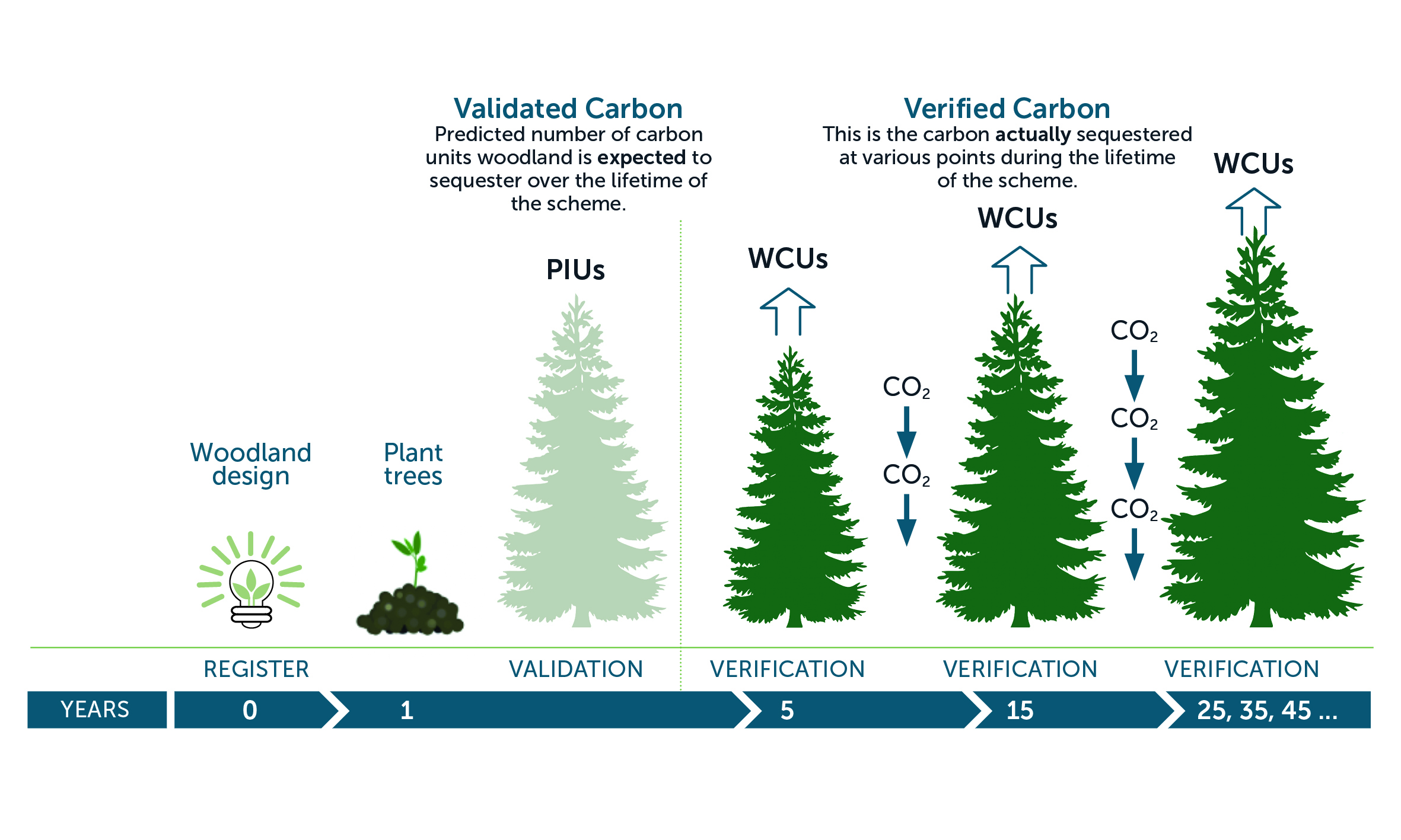
The Woodland Carbon Code is a government scheme administered by Scottish Forestry but available UK wide. The Code allows the owners of new woodland planting schemes to calculate the total carbon sequestration their woodland will achieve over the lifetime of the trees. The planting scheme must then be validated by a third party but once this is done Pending Issuance Units (PIUs) are generated. PIUs have a value and may be sold but may not be used in an offsetting calculation until the trees have grown and the carbon sequestration verified. Verification allows the PIUs to be converted to Woodland Carbon Units which may be used to offset UK based emissions. Woodland Carbon Code schemes may last between 35 and 100 years.
If the carbon is sold there would be a long-term contract between the owner and a third party. This may limit what the owner can do with the woodland.
Peatland is a super carbon store. The hydrology of peatland, in its natural waterlogged state, prevents carbon within organic matter at the surface oxidising and being released as carbon dioxide. Restoration is crucial as degraded peatland has been contributing to rising carbon emissions.
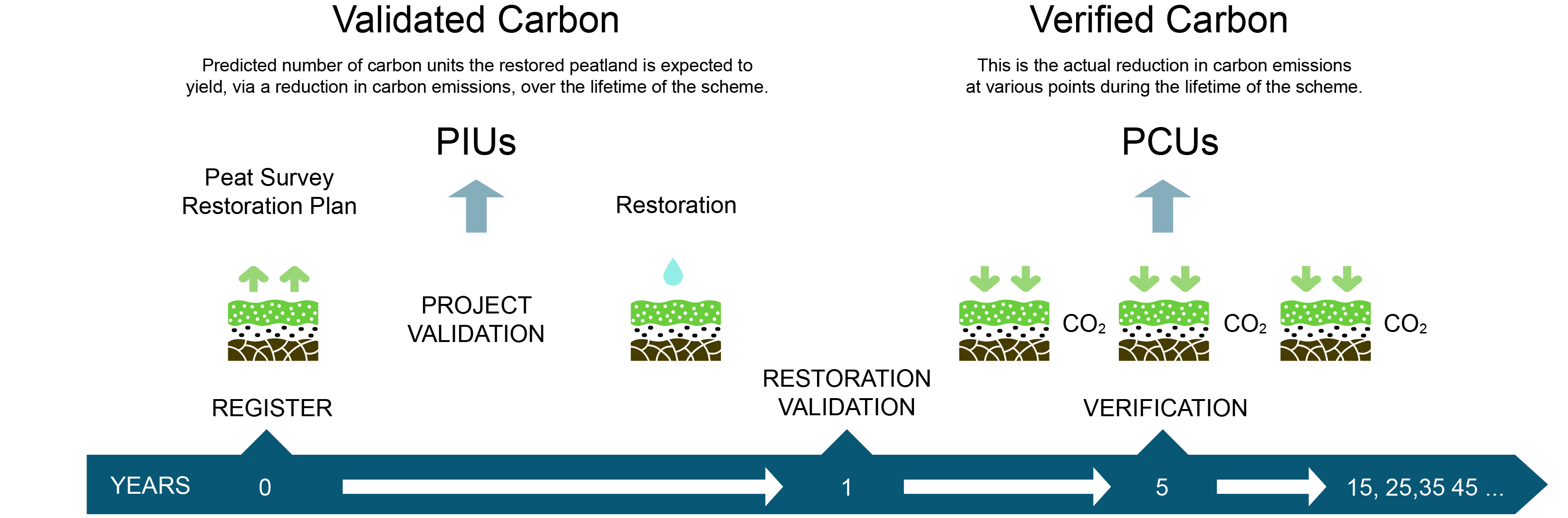
The Peatland Code was developed in 2015 and managed by the IUCN Peatland Programme. The reduction in carbon emissions by peatland restoration is quantified, validated, and verified in a similar way to the Woodland Carbon Code. The emissions reduction benefit from restoring peatlands is permanent and linear therefore the carbon yield is the same ever year for the whole duration of the project. Projects yield Pending Issuance Units (PIUs) at validation and verification allows the PIUs to be converted to Peatland Carbon Units which may be used to offset UK based emissions.
Where an owner has an area of peat, we may be able to work up an integrated woodland and peatland carbon scheme.

case study?